

Intel Core i9-10900K Review
Today we're checking out Intel's new enthusiast and gaming flagship CPU, the Core i9-10900K. Not to be dislocated with the Core i9-10900X which is a pointless 10-cadre Cascade Lake-X role for the LGA2066 socket, the 10900K is a much more than interesting product using the brand new Z490 chipset featuring LGA1200 socket back up and a lower cost to boot.
The Core i9-10900K is a 10-core, twenty-thread processor sporting a base frequency of 3.7 GHz and a single core turbo of 5.3 GHz using Intel'due south new Thermal Velocity Boost. When compared to its predecessor, the 9900K, the L3 cache size has increased from 16 MB to xx MB and the TDP has increased from 95w up to 125w. Besides like the 9900K, the 10900K has the aforementioned $488 MSRP, though in that location are a few issues with this and we'll accost those towards the end of the review, for now nosotros're sure you'd rather nosotros got to the benchmarks as rapidly as possible.

For testing the Ryzen processors we have used the Gigabyte X570 Aorus Master motherboard, while the 8th and 9th gen Intel Core processors were tested on the Gigabyte Z390 Aorus Ultra, and the new tenth-gen Cadre processors on the Asus ROG Maximus XII Extreme. All configurations were tested with an RTX 2080 Ti, 32GB of DDR4-3200 CL14 memory, and a Corsair Hydro H150i Pro 360mm all-in-one liquid cooler.
We've tested the 10900K in two configurations: ane is a stock configuration with the XMP contour loaded which sees the multi-cadre enhancement setting disabled by default, as it should be. The second effect which has been labeled "MCE" features multi-core enhancement enabled, this is substantially an overclocked configuration, like enabling PBO on an AMD Ryzen processor, for case.

While testing on the Asus ROG Maximus XII Extreme and MCE enabled, the board maintained an all-cadre clock frequency of four.9 GHz, but with MCE disabled the frequency dropped as low equally 4.3 GHz. Intel advertises up to a four.nine GHz all-core turbo depending on workload and duration, so it seems Asus is adhering to that spec.

Still, after nosotros had finished all testing nosotros started messing around with other motherboards from other makers and constitute unlike boost beliefs. Using the MSI Z490 Tomahawk, the board by default runs all cores at 4.9 GHz, regardless of duration, and with MSI'due south version of MCE enabled which they phone call 'Enhanced Turbo', the 10900K'southward all-cadre frequency was v.1 GHz. Basically MSI is allowing the Tomahawk to run in the maximum power state indefinitely, whereas Asus is following the Intel spec and after a short period of time reduces the frequency.

What this means is that the MCE results shown in this review are going to be very similar to what you'll come across out of the box with the Tomahawk and some other motherboards. We merely wanted to point that out as you're likely going to see some variance in the results from 1 review to the next, with each board maker interpreting the Intel spec in their own way. We've too gone with the Asus motherboard for all our testing as it was provided by Intel for this review. With all that out of the way, let's go into the results.
Benchmarks

First up we have Cinebench R20 and I retrieve the results seen hither are going to be quite telling for raw multi-core performance. In its default configuration the 10900K scored 6101 pts and that fabricated information technology 25% faster than the 3700X and 9900K. Meanwhile enabling MCE boosted functioning past a further 5% which is pretty typical for this setting.
When compared to the 3900X, the 10900K was 19% slower, so that means it's positioned between the 8 and 12-core Ryzen processors and while that's hardly stocking news, it's a rough place for Intel new x-cadre part to end up given the 3900X tin regularly be institute on sale for a lilliputian over $400, making it cheaper and faster. But before we draw any serious conclusions, permit'southward motion on to check out a lot more than data.

The 10900K is very strong in single core performance, thanks to that 5.three GHz clock frequency. This allowed it to score a very impressive 549 pts making it 3% faster than the 3950X and 6% faster than the 3900X. It's also an viii% improvement over the 9900K which tops out at 5 GHz.

Moving on to the 7-zip compression examination and hither nosotros see the 10900K once again finds itself positioned between the 3700X and 3900X, though it's closer to the 8-core role in terms of performance. Here the 10900K was but 16% faster than the 3700X, making information technology 17% slower than the 3900X.

The margins are like when looking at decompression functioning likewise, here the 10900K was 12% faster than the 3700X but 25% slower than the 3900X. So once more non a keen place for Intel's new flagship desktop offering to exist at.

The Ryzen processors still largely dominate AES encryption performance and the SiSoft Sandra benchmark is one of the more balanced tests. Despite that though the 3900X was 55% faster than the 10900K.
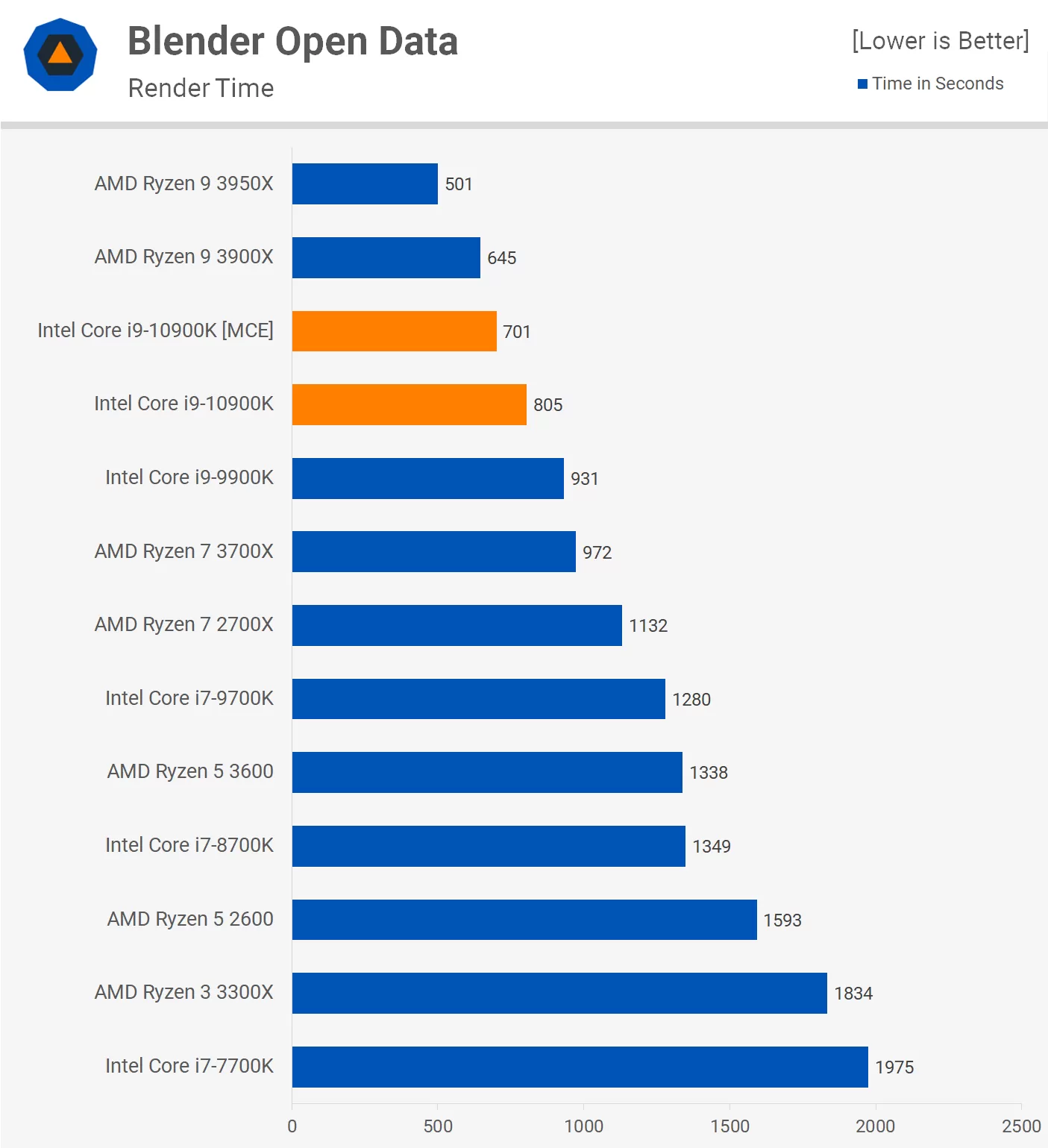
The 10900K is merely xvi% faster than the 9900K in the Blender Open up Data criterion and that made information technology xx% slower than the 3900X. However, enabling MCE does heave performance quite substantially in this test as the all-core clock speed increases from 4.iii GHz to 4.9 GHz, though every bit yous'll run into afterwards in the review this has quite the impact on power consumption.

The 10900K provides a 27% performance boost over the 9900K in the V-Ray criterion and while that meant information technology was thirty% faster than the 3700X, it was still 13% slower than the 3900X. Enabling MCE did boost performance by a further 7%, only you lot can also heave the 3900X by a single digit figure equally well by using PBO.

The 10900K does quite well in the Corona benchmark and with MCE enabled it was able to match the 3900X, so there is that. Stock though information technology was 10% slower.
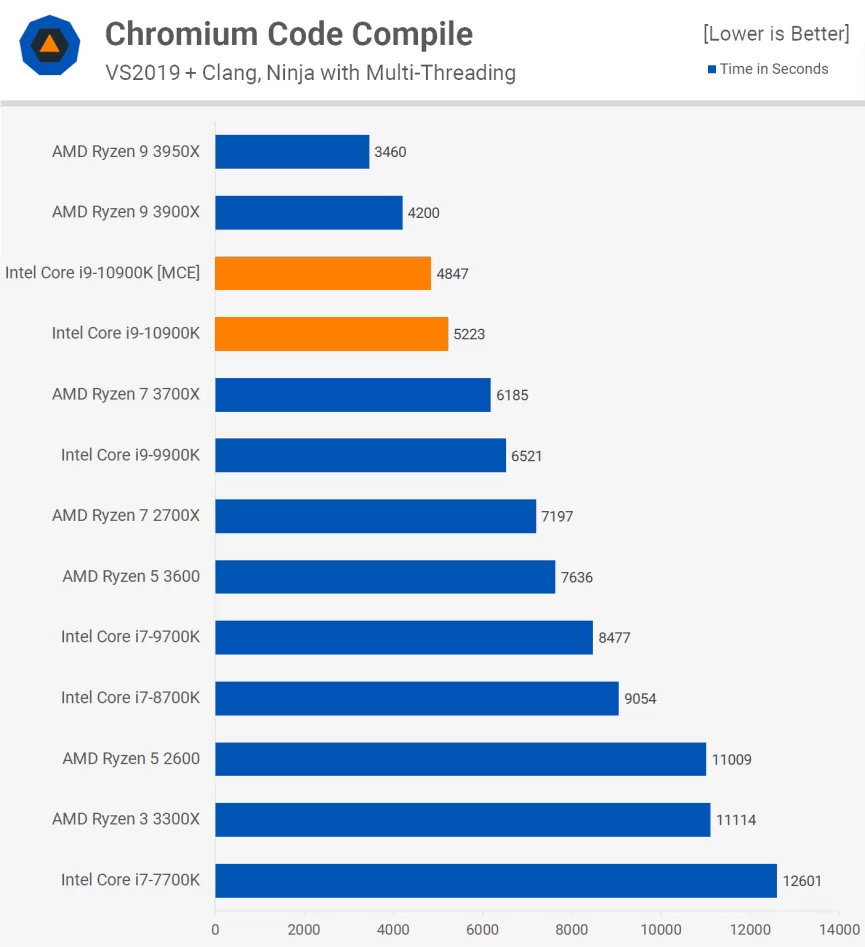
Here's a expect at code compilation performance and here the 10900K once once more finds itself positioned betwixt the 3900X and 3700X. Basically it was 18% faster than the 3700X but still 20% slower than the 3900X and that seems to be the 10900K in a nutshell when it comes to productivity performance.

Moving on to video editing performance with DaVinci Resolve Studio 16, here nosotros meet the 10900K is barely able to outperform the Ryzen 7 3700X, boosting performance by 1.v%. That meant the 3900X was 9% faster, non a huge margin by any means, but the slightly more affordable Ryzen processor was faster in this examination.

The 10900K was more competitive in Premiere Pro every bit information technology outscored the 3700X by a 14% margin, making it but 5% slower than the 3900X. And then a decent result and certainly a big performance uplift from the 9900K.

Photoshop benefits from strong single core performance and as a result the 10900K performed very well, chirapsia even the 3950X by a vii% margin. So if y'all're later every concluding bit of performance in Photoshop the 10900K is the way to get.

The 10900K was also strong in After Furnishings, matching the 3900X, so while not an outright win, it was just as fast.
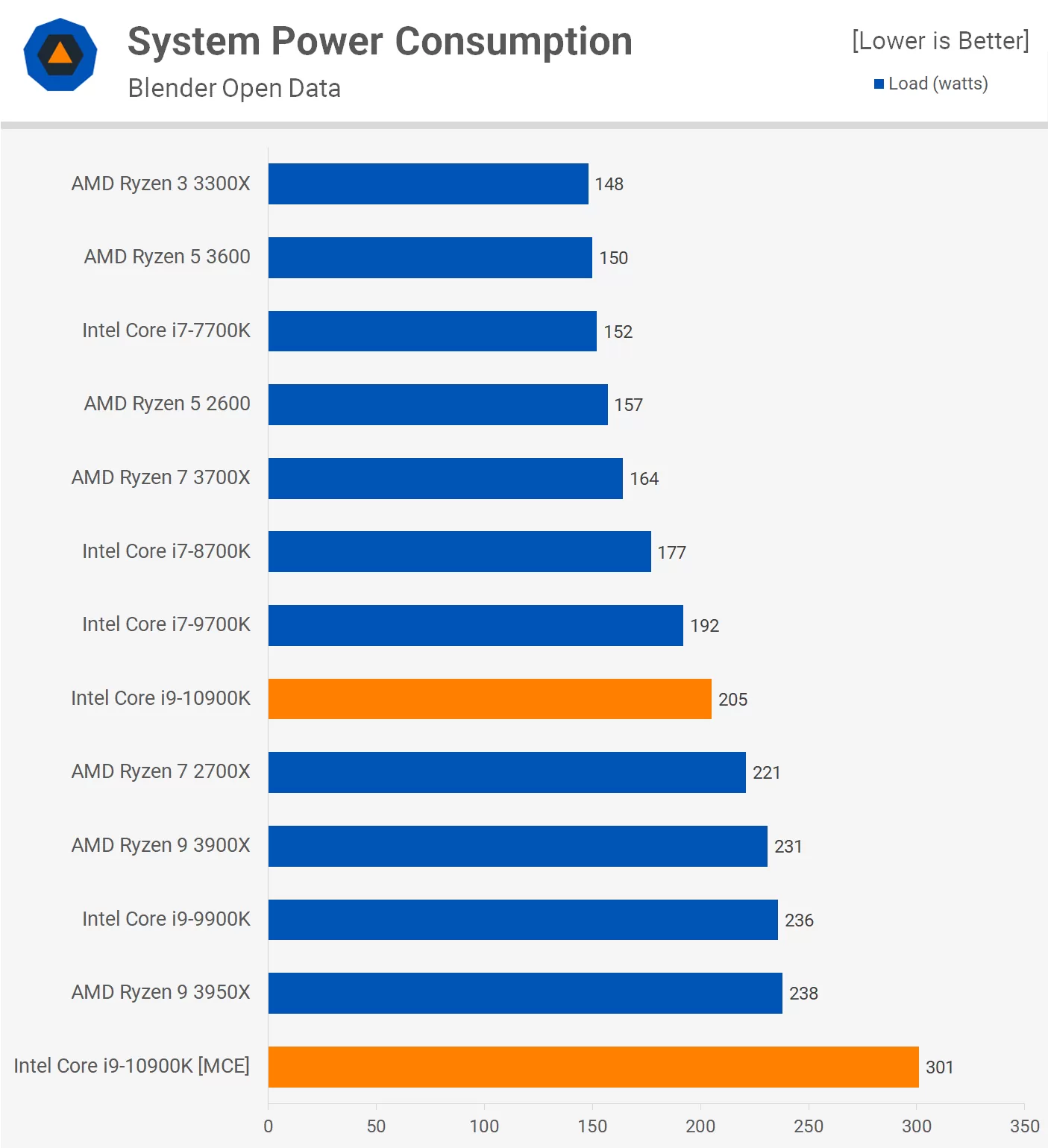
Hither'southward a look at power consumption and as you lot can see when adhering to the 125 TDP spec, the 10900K sips power as full system usage is simply below that of the Ryzen 7 2700X, so that'due south a pretty skilful result. We should note that this is the sustained power usage once the processor backs all cores down to 4.3 GHz, prior to that ability consumption looks like what nosotros see with MCE enabled.
Speaking of which, with MCE enabled which is the stock configuration for many other Z490 boards, power consumption skyrockets and now we're looking at just over 300 watts for the total system.
Gaming Benchmarks


Time for some gaming benchmarks, first looking at Battlefield V tested at 1080p using the ultra quality preset with a GeForce RTX 2080 Ti graphics card. Here the 10900K basically matched the 9900K and that meant it was 8% faster than the 3900X, pushing the average frame charge per unit up from 156 fps to 168 fps.
As expected that margin shrinks as we move to the more GPU leap 1440p resolution and now the 10900K was but 5% faster than the 3900X.


Far Weep New Dawn highlights a worst instance scenario for Ryzen and hither the 10900K is xviii% faster than the 3900X which is a significant margin. Pushing 134 fps on average opposed to 114 fps will be more than desirable for high refresh rate gamers no doubt.
The margin remains much the same at 1440p as even here nosotros're mostly CPU bound, as a result the 10900K was still 16% faster than the 3900X.


We see fairly typical margins in the new Gears Tactics game, here the 10900K was 8% faster than the 3900X when comparing the average frame rate and eleven% faster when comparing the 1% low results.
The margins practise close up quite a bit at 1440p and here the 10900K was 6% faster than the 3900X when comparison the average frame rate, just interestingly nosotros encounter no difference for the 1% low outcome, leading to a very like gaming experience.


Moving on to Rainbow Six Siege, nosotros're looking at a 3% boost in operation for the 10900K over the 9900K, with a 5% improvement in 1% low functioning. Not exactly mind-blowing stuff, but as promised by Intel the 10900K is now the earth's fastest gaming processor. It was likewise just half-dozen% faster than the 3900X, but with both pushing well over 200 fps at all times, I'k not sure how much that margin matters anyhow.
Once again, 1440p helps to bring everything together and at present the 10900K is only 3% faster than the 3900X or two% when comparing the 1% low results.


Ghost Recon Breakpoint isn't a especially CPU demanding title. The 10900K was but 5% faster than the 3900X in this game and nosotros'd say this is a fairly accurate representation of mod gaming performance.
The margin really opens up a little at 1440p, now the 10900K is vii% faster than the 3900X, non exactly anything to get excited well-nigh, just you can enjoy a few extra frames.


Shadow of the Tomb Raider is very CPU demanding, particularly the open up globe section nosotros use for testing and on that note, just to be articulate, these results oasis't been recorded using the built-in benchmark which we feel isn't every bit enervating and not a good way to test CPU performance in this title.
Nosotros're using OCAT to measure out in-game performance and here we run across very strong results from the 10900K when looking at the 1% low information. It was 22% faster than the 9900K and 14% faster than the 9700K which appears to fare better with Hyper-Threading disabled, though that's not unusual every bit we come across this sort of matter quite often.
Moving to 1440p sees the higher-end CPUs high a GPU bottleneck and as a result the 3900X, 3950X and 10900K all deliver the same 99 fps on average and 91 fps 1% low.


Finally, we take Blood-red Dead Redemption ii with dialed downwardly quality settings and despite that nosotros're nonetheless running into a strong GPU bottleneck with the higher-end CPUs, limiting performance to just over 100 fps on boilerplate.
The aforementioned thing is seen at 1440p, though the slightly higher single core performance of the 10900K appears to give it a minor reward, though we're taking just a ii% boost over the 9900K.


Let's bank check out the average of the seven games. Given what we just saw information technology won't surprise you to larn that on average the 10900K is vii% faster than the 3900X. That'south non a big margin at 1080p when using an RTX 2080 Ti, but it does mean Intel retains the gaming operation crown.
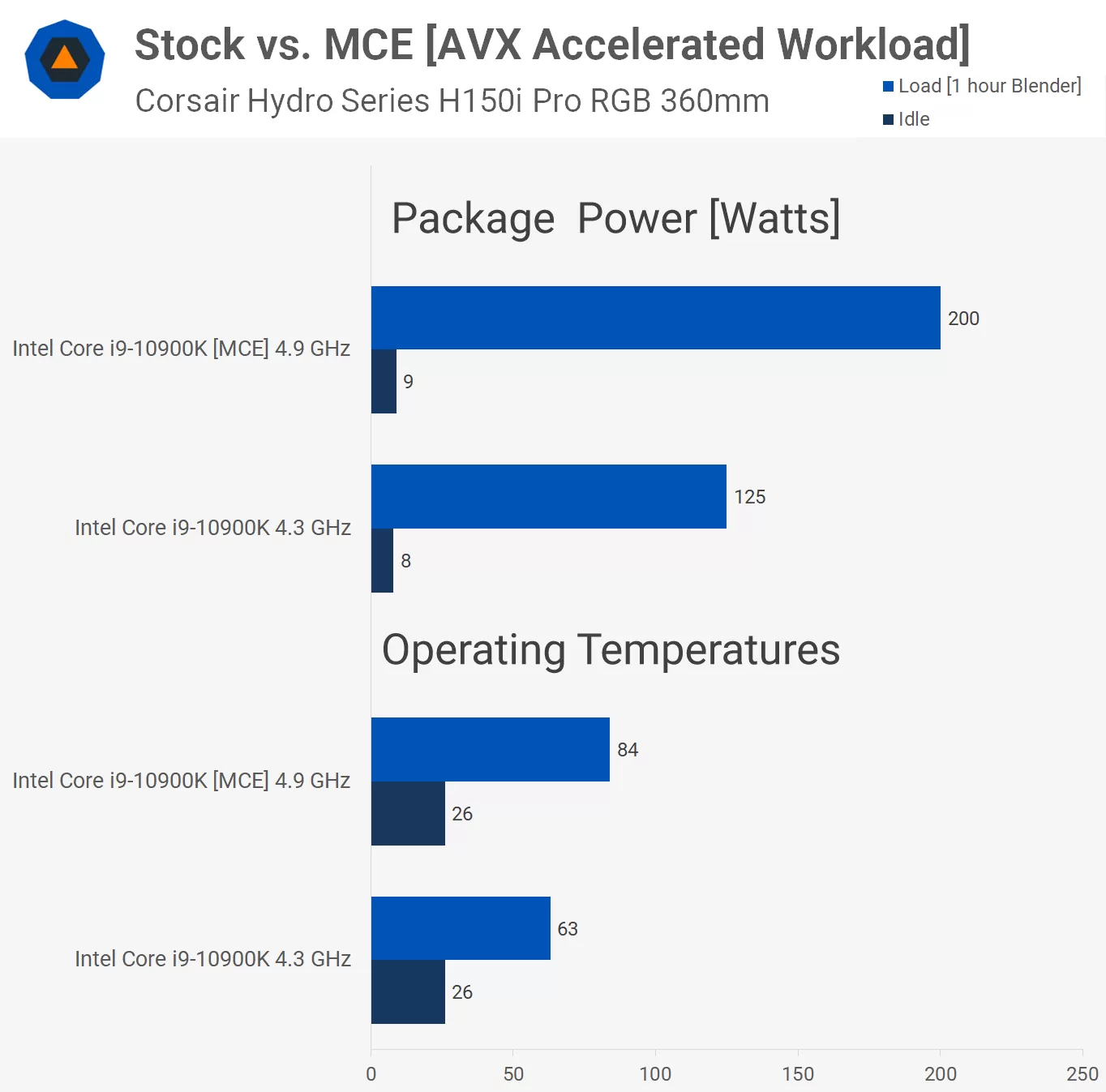
Operating temperatures were recorded during our Blender stress test, with the Corsair Hydro H150i Pro installed. Stock the Core i9-10900K peaked at just 63c which is lower than we were expecting, just power usage is pretty adept, all things considered, with a parcel ability of 125 watts. Voltage optimization and a stringent binning procedure is to thank hither equally all 10-cores clocked at iv.iii GHz required just 1.03v.
However, one time y'all enable MCE and unleash that actress performance, that pushes the operating temperature upward to 84c, which again is lower than we were expecting given package power hit 200 watts and hither the CPU was fed one.172v.
What We Learned
One time we've had a good expect at how the Core i9-10900K performs in applications and games, and of course, how it stacks upwardly against AMD'southward competing Ryzen processors. The question now is, should you buy it?
Permit'due south outset by addressing that question based purely on the performance nosotros've seen so far. When it comes to gaming, the new 10-core Intel processor was up to eighteen% faster than the 3900X, merely on average it was ~7% faster and frankly you'd be hard pressed to tell the difference. In fact, for the vast bulk of games it'll merely be incommunicable. Not to mention that the vii% deviation was seen at 1080p with an RTX 2080 Ti. If we compare the 1440p information, the 10900K is just 5% faster than the 3900X when comparing average frame rate and 1% depression data.

When information technology comes to productivity applications we found that the 10900K was up to 35% slower than the 3900X and at that place were a number of instances where it was slower by a 15% margin or greater. Moreover, in the rare example where the Cadre i9 processor was actually faster, we were looking at unmarried digit gains. For example, you're near certainly not going to notice a nine% performance heave in Photoshop, but you lot'll surely notice a 15% or greater reduction in pinch, code compilation or rendering/encoding operation.
There'due south also the matter of functioning per watt, and due to unfortunate circumstances that have seen Intel stuck on the 14nm process for significantly longer than intended, the 10900K is very power hungry. For the most office, nosotros don't see this being likewise much of an outcome, using a decent cooler will keep the ten-core Comet Lake CPU cool plenty, just it'due south nonetheless using a lot more power and in applications like Blender, it does then while delivering significantly less performance.

We feel in terms of performance the Cadre i9-10900K is a tough sell and it'southward been reduced to become a niche product. Who should desire to buy the 10900K? Perhaps someone who wants ultimate gaming performance and amend video rendering than a 10700K, but for any reason doesn't want to sacrifice some gaming performance in favor of even better video rendering, at a lower price with the 3900X.
With the Ryzen ix 3900X downward around $410 -- surely no coincidence, AMD is trying to squeeze Intel hither -- the CPU has been available for effectually that price since March, the 10900K is fetching a serious premium at $530, the current pre-social club price right at present. In other markets like Commonwealth of australia, we're seeing pricing that is ~30% more than the 3900X. That's a massive price premium that it's simply non worth paying. If the 10900K was coming in at $410, we could certainly make an argument for purchasing it over AMD's 3900X, specially if you lot're just gaming.

However, the biggest problem with the Core i9-10900K might non fifty-fifty exist its functioning or the cost, but rather availability. There'southward been plenty of speculation recently that the 10th-gen Core series release is closer to a paper launch than Intel is willing to acknowledge. We accept it on good say-so that this is indeed the example with pre-orders opening up a few weeks agone, retailers take very little stock and while the need hasn't been crazy, it's heavily outstriped supply, leaving retailers with orders they just can't fill. In other words, the chances of getting a Core i9-10900K in the short term volition be extremely remote and from what we can assemble, Intel isn't promising retailers whatever kind of supply at this point. If supply is going to be so express, that will see toll scalping and volition ultimately outcome in buyers going with Ryzen instead.
On another notation, it's crazy to think that it'south been half dozen months since the release of the Ryzen 9 3950X and Intel still has no answer, leaving AMD to command the highest cost on the desktop. Simply two years agone Intel was charging $1,000 for their fully fledged x-cadre desktop part, the Cadre i9-9900X. Today you're getting a slightly faster chip for half that, more than evidence that competition is a good thing.
As for motherboard pricing, information technology looks like in that location are some decent Z490 options for under $200, which seems reasonable and at the very least is comparable to AMD's X570 lineup.
Afterwards this week nosotros'll be looking at the Core i7-10700K, followed by the Core i5-10600K and then we're hoping nosotros can get our hands on some Core i3 models, though no word on availability there either. That'southward going to practise it for our kickoff look at the 10900K and exercise let us know what yous think about this new part from Intel.
Shopping Shortcuts:
- Intel Core i9-10900K on Amazon
- AMD Ryzen 9 3900X on Amazon
- AMD Ryzen 9 3950X on Amazon
- Intel Core i9-9900K on Amazon
- AMD Ryzen 7 3700X on Amazon
- AMD Ryzen v 3600X on Amazon
- GeForce RTX 2070 Super on Amazon
- GeForce RTX 2060 Super on Amazon

Source: https://www.techspot.com/review/2028-intel-core-i9-10900k/
Posted by: washingtondrathey.blogspot.com
0 Response to "Intel Core i9-10900K Review"
Post a Comment